


Rectal Cancer vs Colon Cancer: Key Differences in Treatment
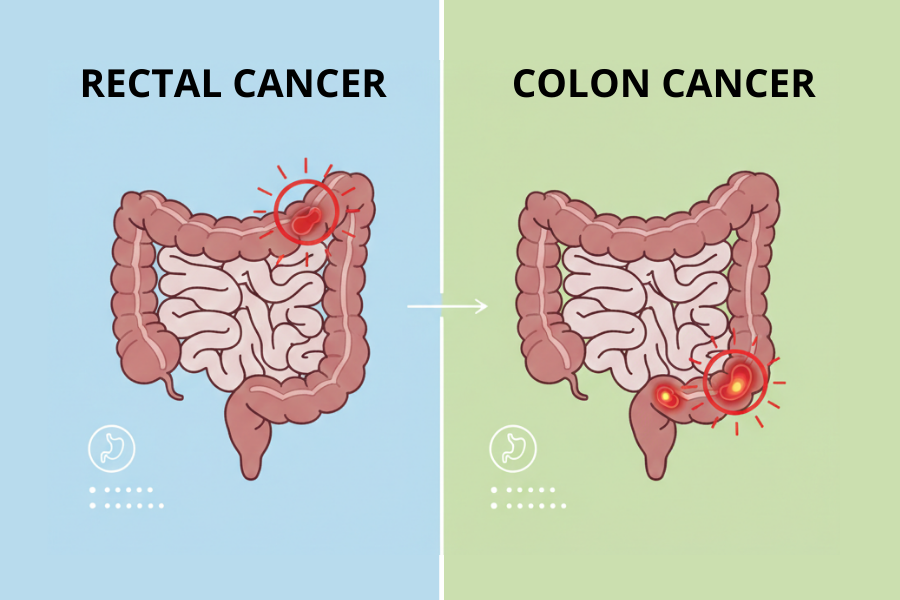
Colorectal cancer is often discussed as a single disease, but medically it includes two distinct conditions -colon cancer and rectal cancer.
Although both arise from the large intestine, their location, treatment approach, and surgical planning differ significantly.
Understanding this difference is important because rectal cancer requires more precise evaluation and multidisciplinary treatment to preserve function and achieve the best outcomes.
1. The Anatomical Difference Between Colon and Rectum
The large intestine has two major parts:
- Colon – the long abdominal segment where stool forms
- Rectum – the final 12–15 cm portion located deep inside the pelvis
1 Why Location Matters
The rectum lies in a confined pelvic space surrounded by critical structures:
- Bladder
- Urinary nerves
- Sexual function nerves
- Pelvic floor muscles
Because of this close proximity, treatment must balance cancer removal with preservation of normal function.
2. Why Rectal Cancer Needs Special Planning
Colon cancer surgery usually involves removing the affected segment of bowel and reconnecting it.
Rectal cancer treatment is more complex due to limited surgical space and higher risk of local recurrence.
1 Goals of Treatment
Management aims to:
- Completely remove tumor
- Prevent recurrence in pelvis
- Preserve continence
- Preserve urinary and sexual function
This requires coordinated planning before surgery.
3. Role of Staging Before Treatment
Detailed staging determines the depth of tumor invasion and lymph node involvement.
1 Imaging Evaluation
Commonly used methods assess:
- Tumor penetration depth
- Relationship to surrounding organs
- Nodal spread
Accurate staging guides treatment sequence rather than immediate surgery alone.
4. Multimodality Treatment Approach
Unlike many colon cancers, rectal cancer often requires combined therapy.
1 Radiation Therapy
Used to shrink tumor and reduce local recurrence risk.
2 Chemotherapy
Helps control microscopic disease spread.
3 Precision Surgery
Performed after planning to remove tumor while protecting pelvic nerves when possible.
This staged approach improves long-term control rates.
5. Why Expertise Matters
Because of anatomical complexity, small differences in planning can influence:
- Bowel control
- Bladder function
- Sexual function
- Risk of recurrence
Specialist evaluation helps tailor treatment sequence appropriately.
6. Follow-Up After Treatment
Regular surveillance ensures early detection of recurrence and monitoring of recovery.
Follow-up may include:
- Clinical assessment
- Imaging when indicated
- Endoscopic evaluation
Conclusion
Rectal cancer is not simply a lower form of colon cancer.
Its deep pelvic location requires careful staging and a combination of therapies rather than surgery alone.
Proper planning and specialised care significantly influence functional outcomes and disease control.